An AI receptionist for small business. How we rebuilt the website, pricing, SEO and voice agent in three days, and what we gave up on the way.
← All WorksA 3D fly-over of the site, 14.5 s, drawn in code (WebGL).
Product
ZeroFlow, zeroflow.eu, a product of OpenWeb360 OÜ
What it is
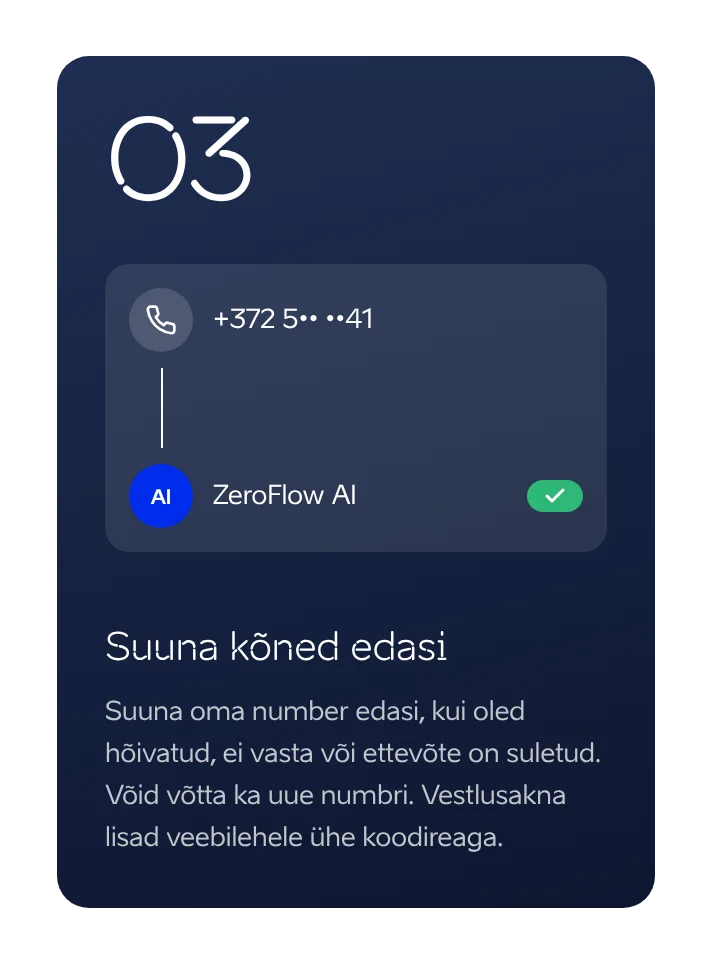
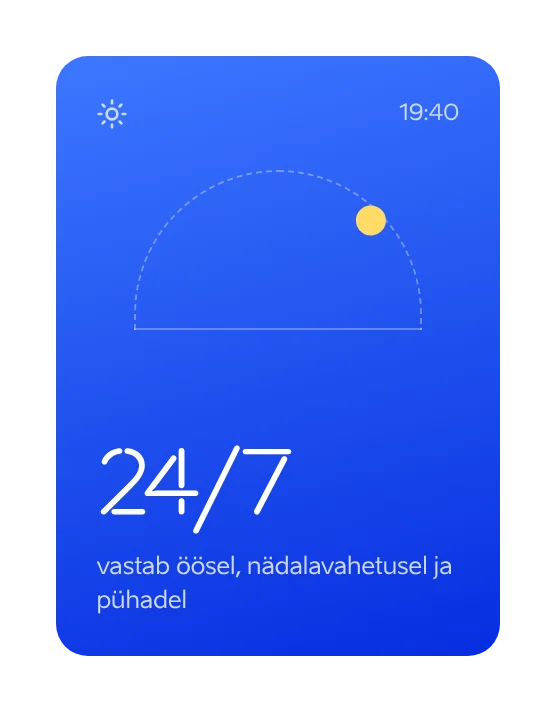
An AI receptionist for small business: a voice agent answers calls 24/7, finds out what the customer needs and sends a ready request to e-mail or Telegram
Industries
beauty salons, dental clinics, car services and tyre shops, plumbers and handymen
Market and languages
Estonia; Estonian, Russian and English (both the site and the agent)
Timeline
first version in July 2026; rebuild on 16–18 October 2026 (10 releases in 3 days)
Scope
positioning, redesign, structure, pricing, trust and enterprise, SEO and AI search, voice agents, voice + chat widget, analytics, infrastructure, marketing video
ZeroFlow started in July 2026: the site was built in Lovable, in August came the articles (the cost of missed calls, payback, what a voice agent is) and an ROI calculator. For a first version this is a sensible path: fast, cheap, you can test the idea. By October the problems were about business, not technology:
The home page repeated itself. «0 missed calls», an industries accordion, a «three languages» chat, a calculator: each block is fine on its own, together they hide the main thing: you can call and talk to the agent right now.
Prices were unclear. Minutes and calls: a salon owner does not know how long a customer call takes, and is afraid of the bill.
The site was not built for search. Pages were not ready for indexing in three languages, and search through AI (ChatGPT, Claude, Perplexity) was not on the table.
Nothing to show to large customers. A company with a contact centre asks about data, a processing agreement and an SLA, and there was no answer.
The site lived on someone else's hosting. A builder subscription and limited control over code, security headers and SEO.
The widget could only suggest calling. Although the product is about conversation.
The task: turn the site from a «nice business card» into a sales tool that explains the price itself, proves reliability itself and lets you try the product in 10 seconds.
What we did and why
1. Positioning
What we did. We chose a «state-grade trustworthy» style: light, calm, with a frosted-glass effect and a soft coloured glow behind the page. estonia.ee was the reference.
Why. The product answers customers' calls instead of the owner. Trust matters more than effect here: if the page looks like a startup toy, a dental clinic owner will not hand it their phone.
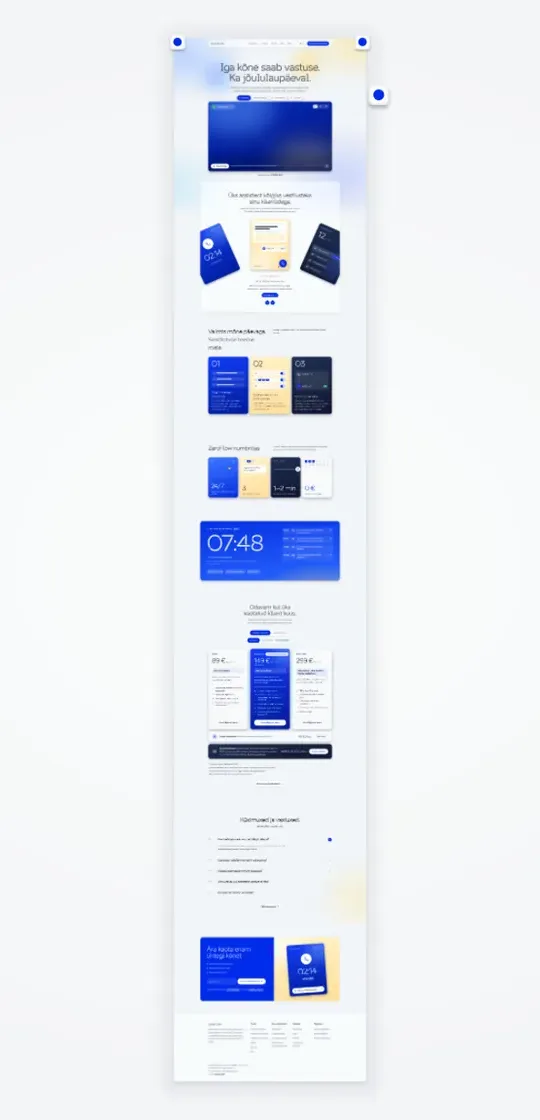
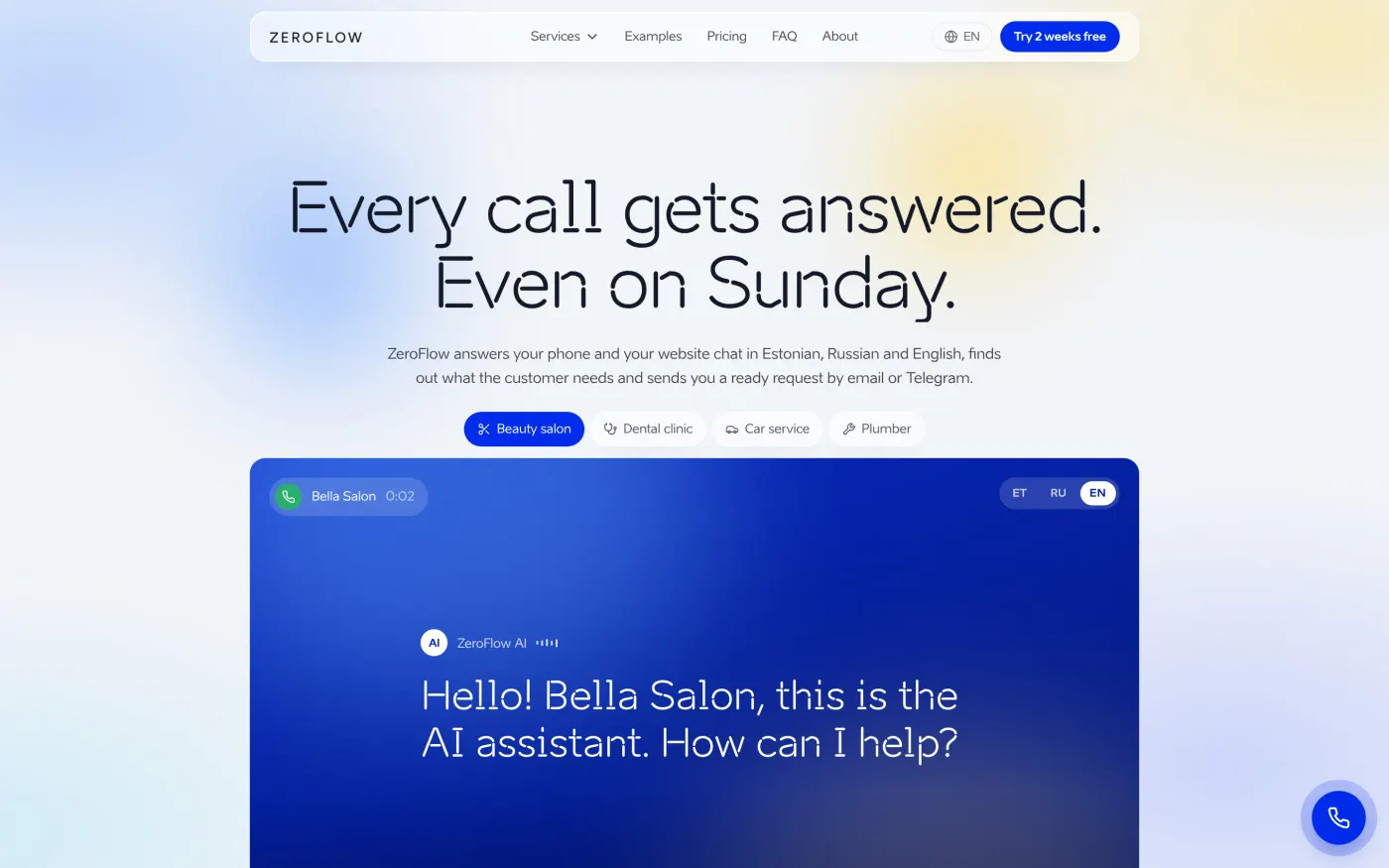
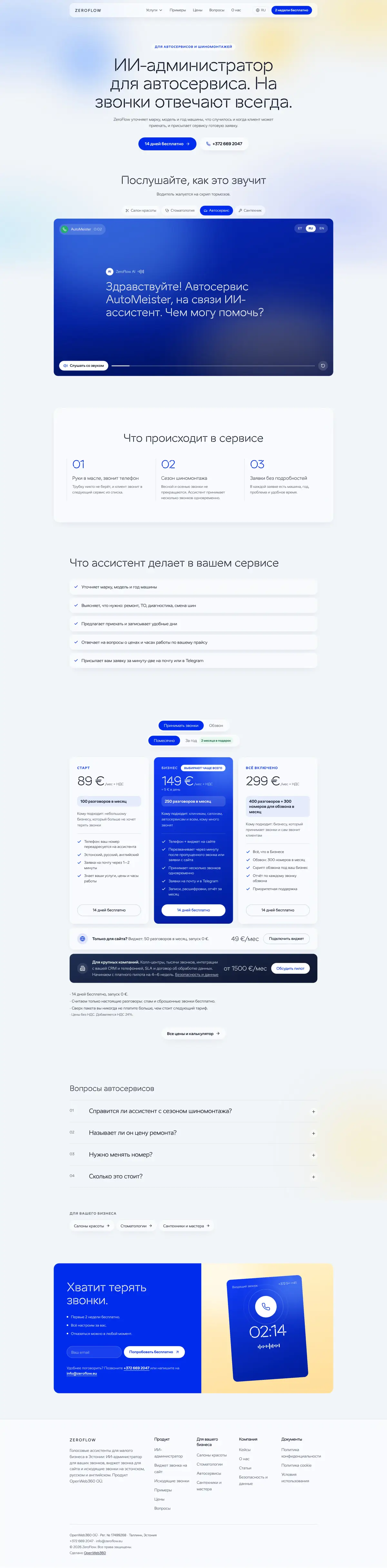
The home page after the rebuild (scroll inside the frame).
2. Structure and design
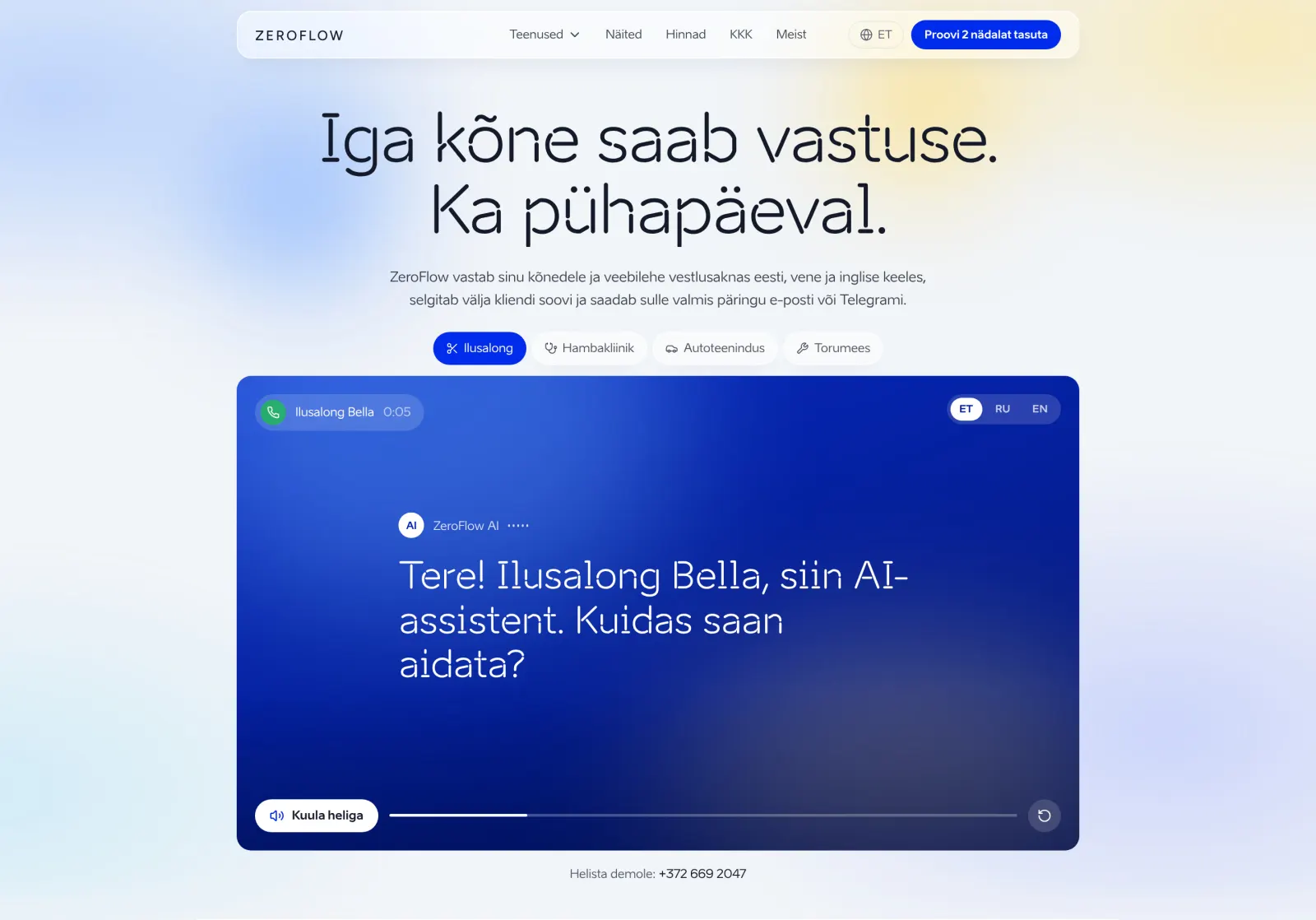
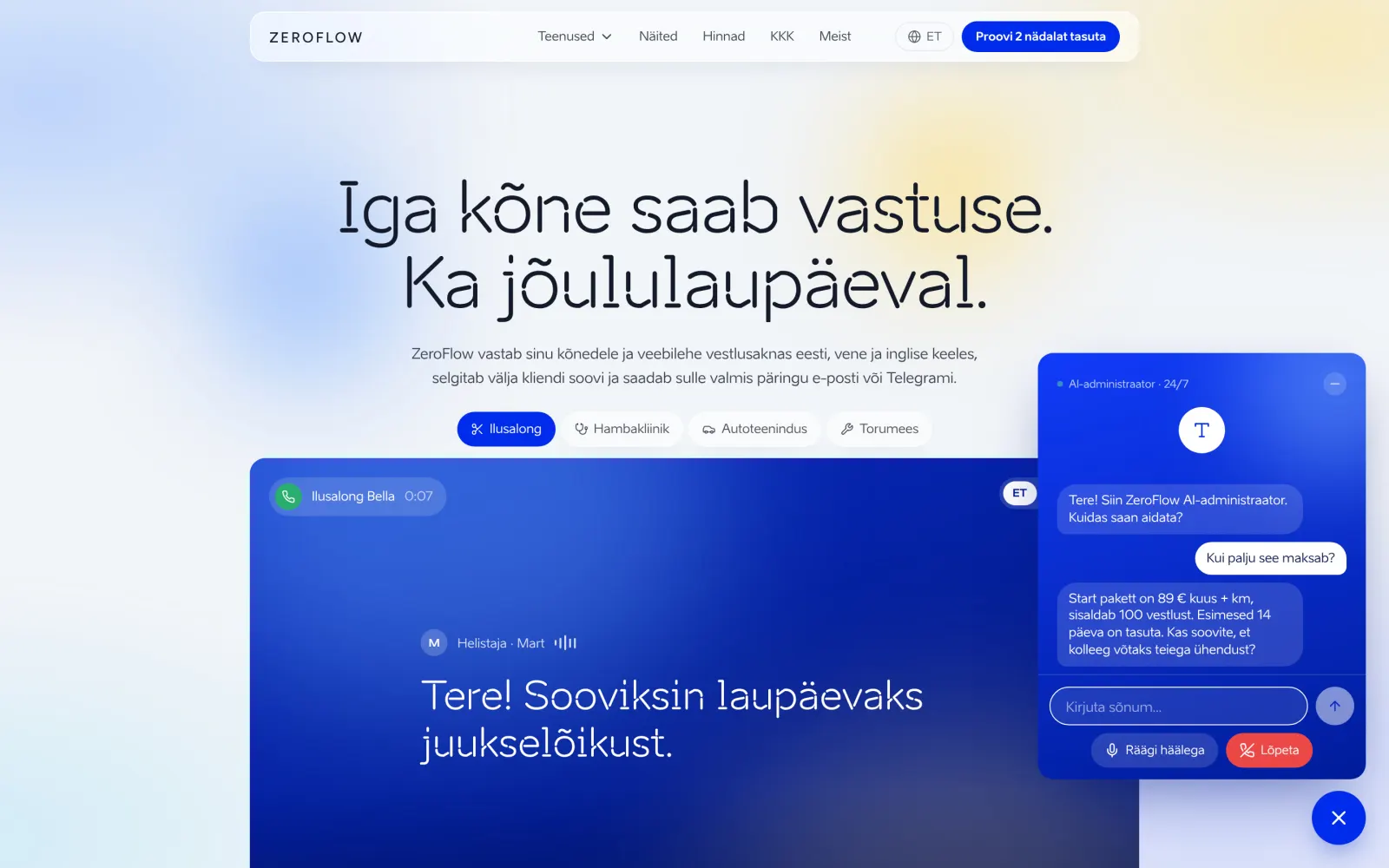
What we did. We shortened the home page: the repeating blocks went, the calculator moved to the pricing page. The new order: the demo on the first screen (live conversation examples for four businesses: salon, dental clinic, car service, plumber) → services → how it works → numbers → the «night story» (an example request at 07:48 after a night call) → pricing → FAQ → the final call to action. We removed the old call-back widget (Retell): the home page now promotes the demo line on ElevenLabs. Finally, polish: drop-down menus were semi-transparent and hard to read, so we made them opaque and audited every page.
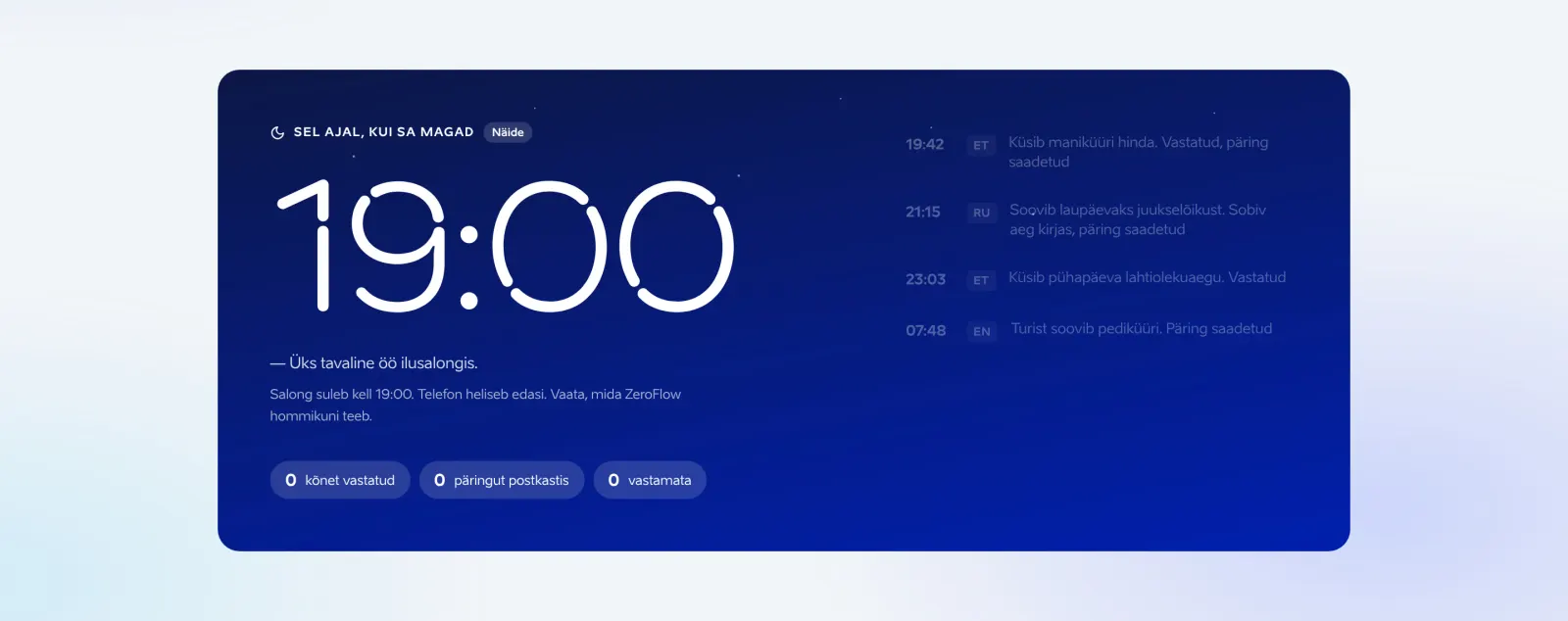
Why this way. The product is about conversation, so conversation comes first: the visitor presses an industry, hears and sees a live example, and only then reads about services. The «night story» sits next to pricing because it is the most visible answer to «why do I need this»: a call at 23:03, a request in the morning.
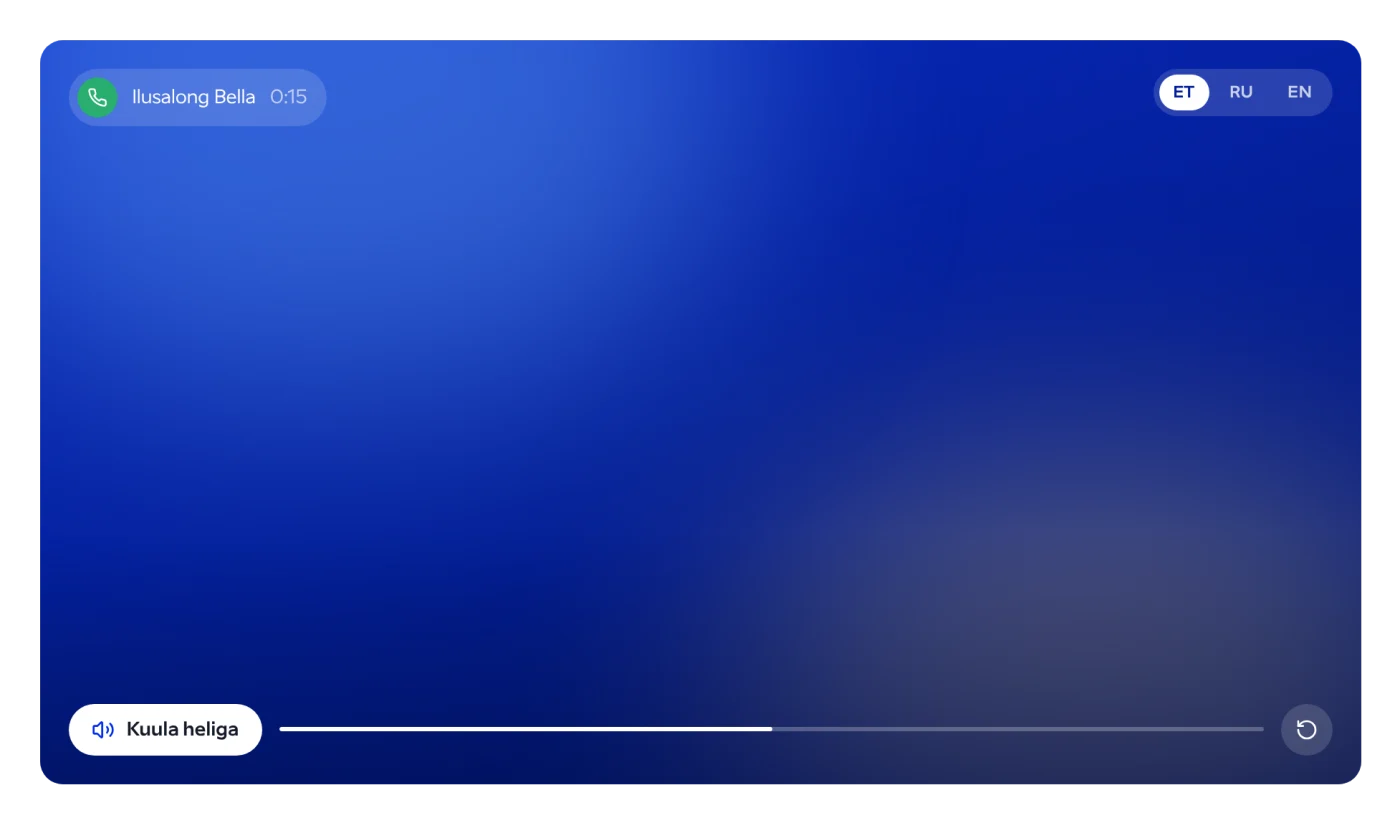
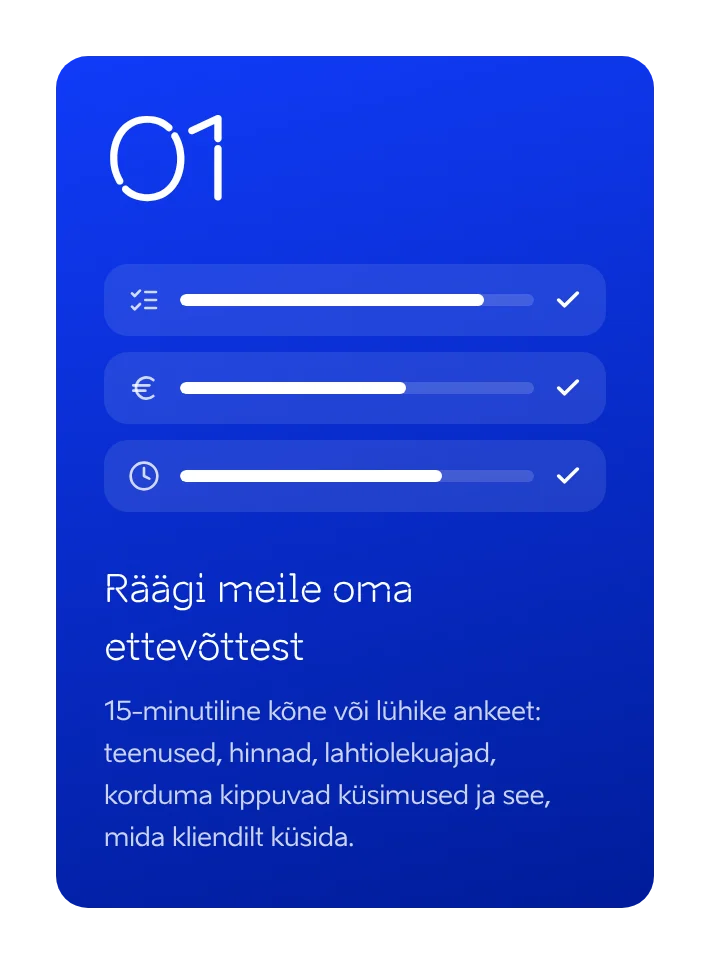
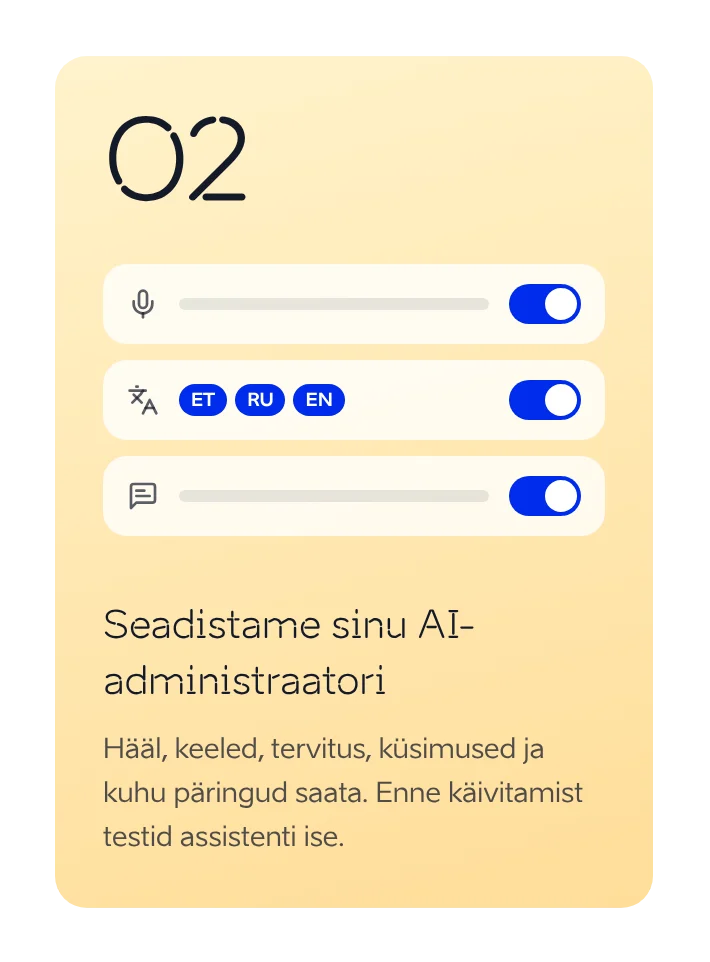
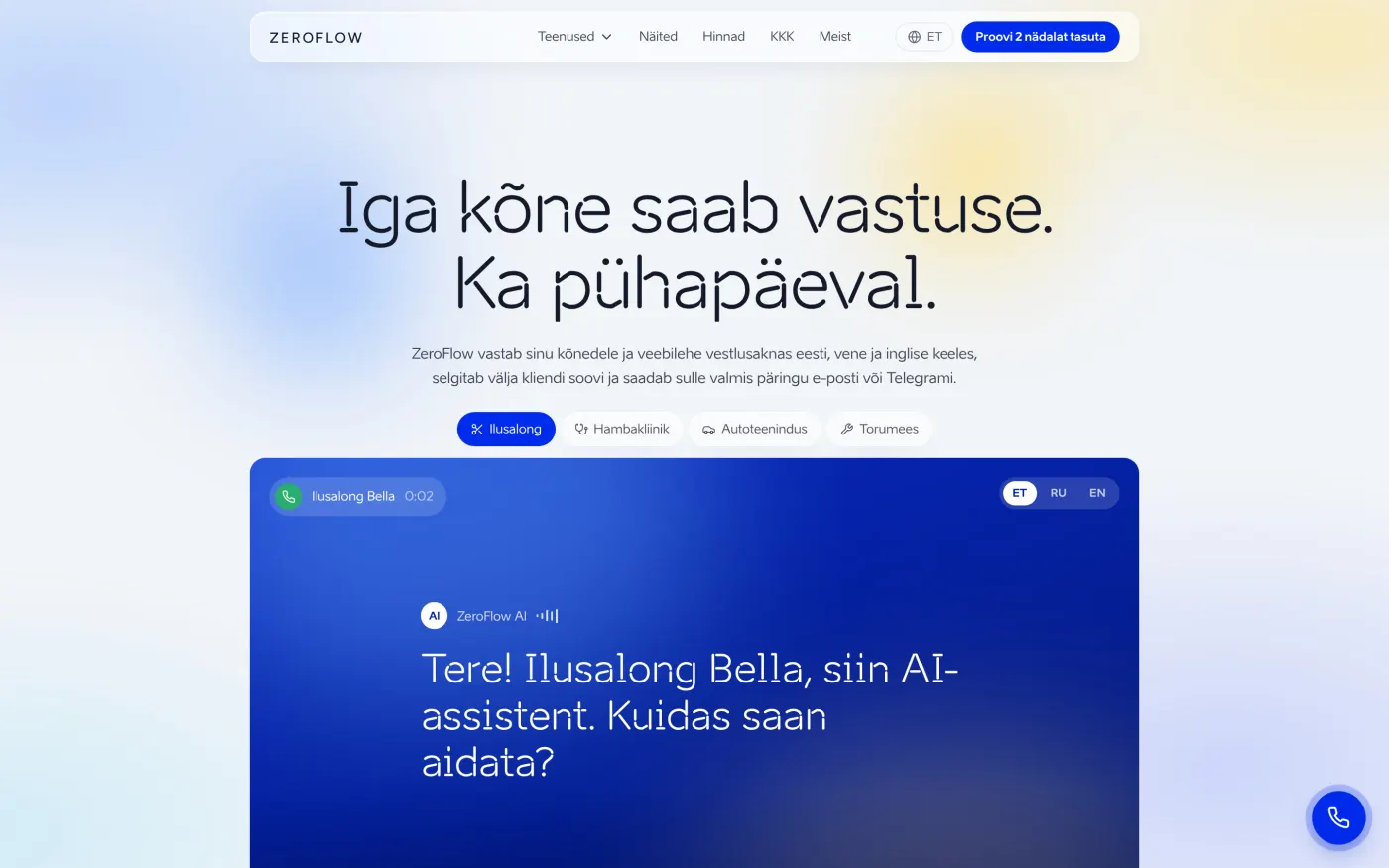
The new home page structure in one strip (a frame from the video).The first screen: headline, industry buttons and the call window.Four demo scenarios: salon, dental clinic, car service, plumber.The demo call window: a live conversation with a beauty salon.«How it works»: three steps.The «night story»: requests at 19:42, 21:15, 23:03 and 07:48 in Estonian, Russian and English (an example).The numbers block: four cards.
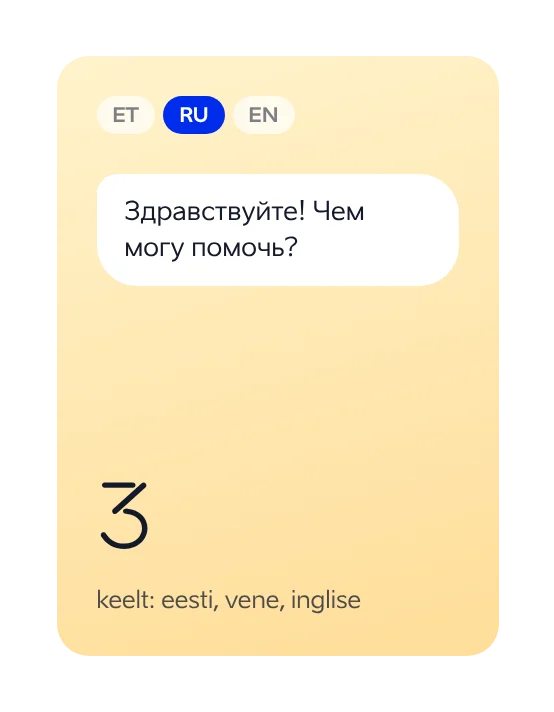
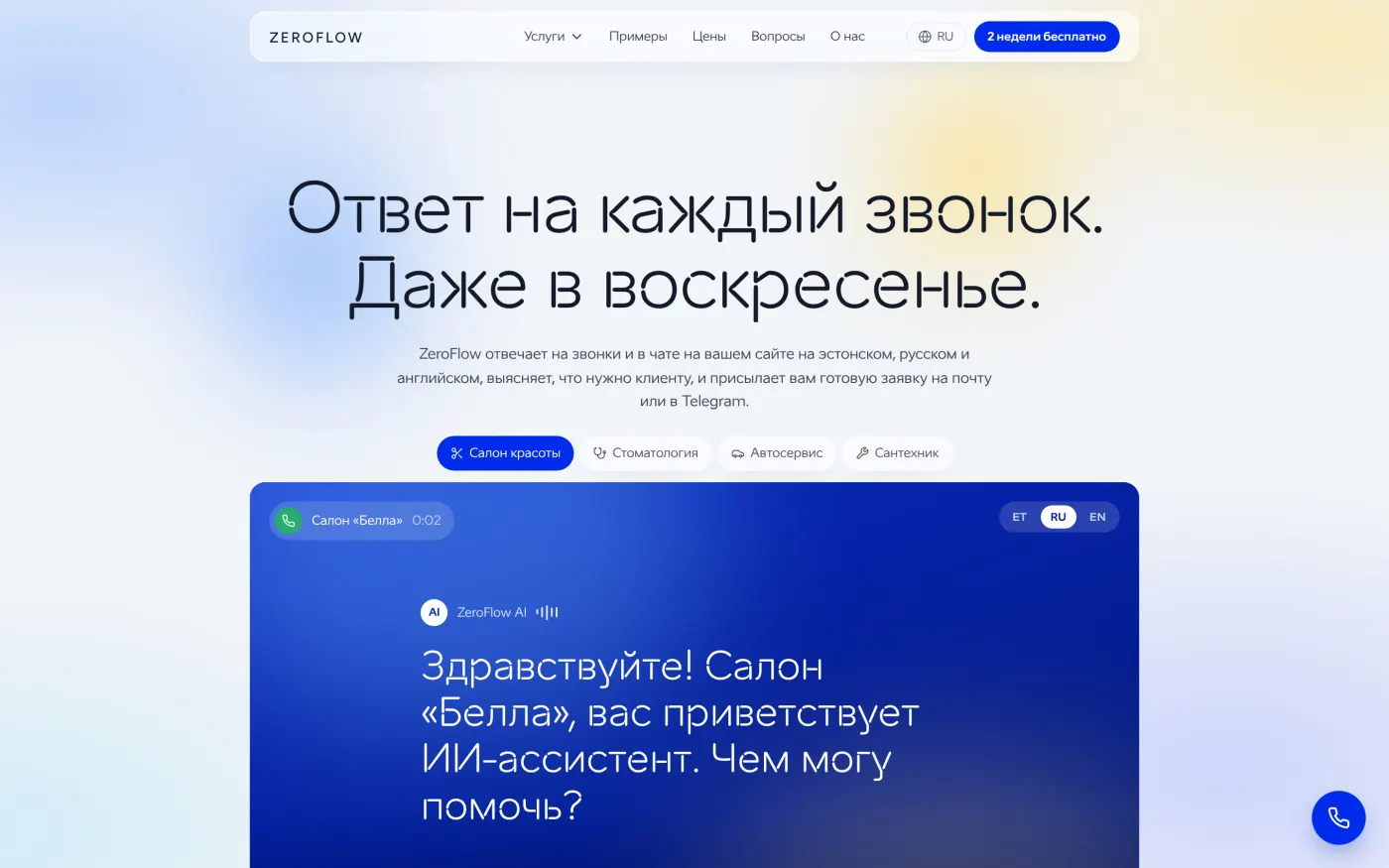
Three languages. The site fully exists in Estonian, Russian and English, and it is not a «translation for the tick box»: every language has its own headlines and descriptions, and the language versions are linked to each other.
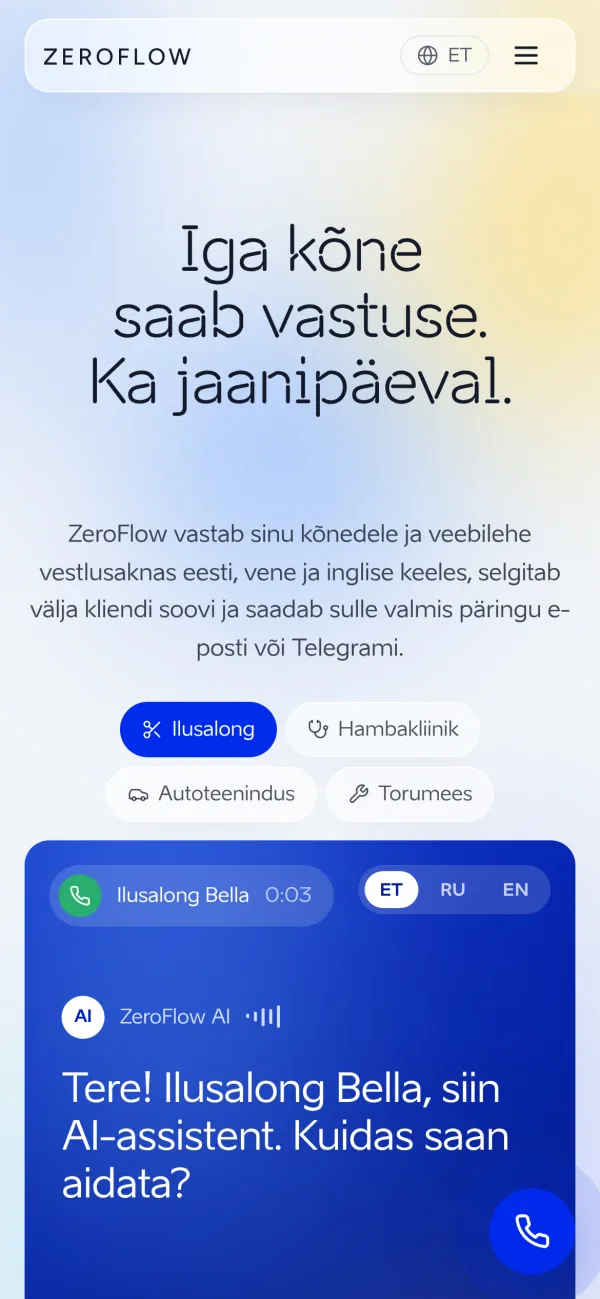
The first screen in Estonian, Russian and English.The same first screen on a phone.
3. Pricing and packaging
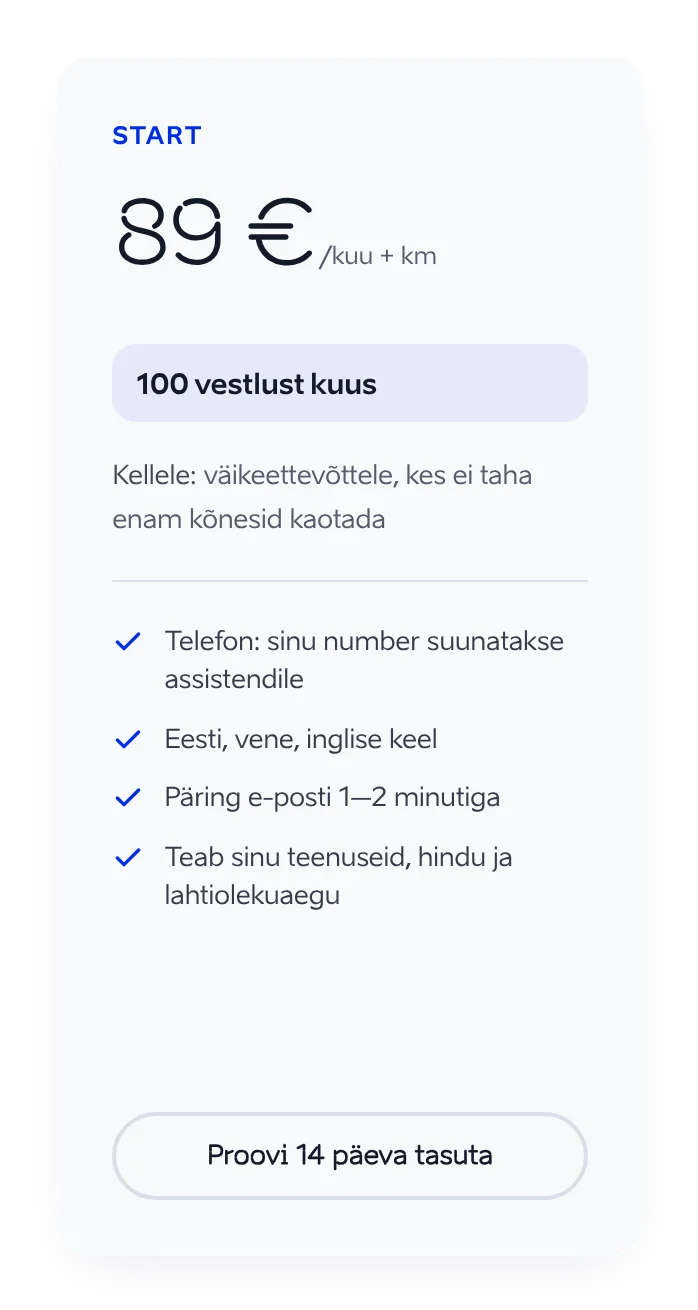
What we did. We started from unit economics, not from a pretty number. We counted the cost of voice-AI minutes (platform credits), VAT, margin and the cost of test calls. Then we moved from «calls and minutes» to paying per conversation.
Plan
Price
What is included
Start
€89/month + VAT
100 conversations
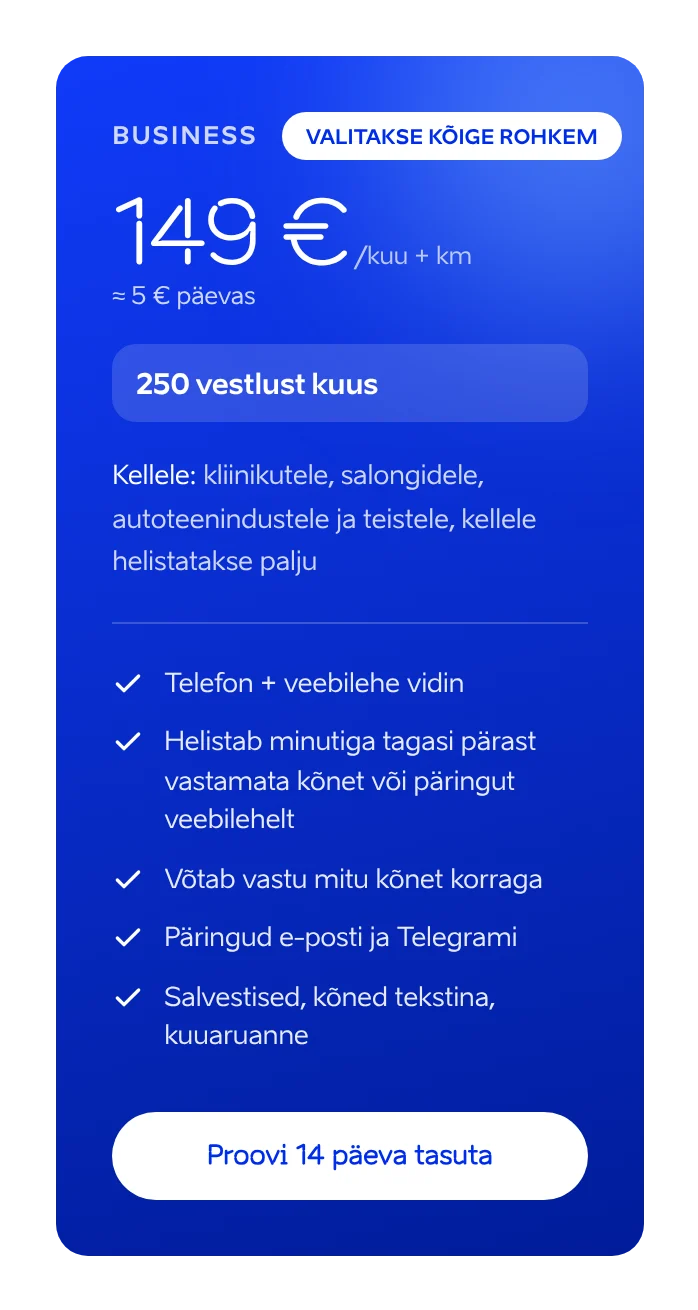
Business
€149/month + VAT
250 conversations, a website widget, a call-back after a missed call; a «most chosen» badge and the line «≈ €5 a day»
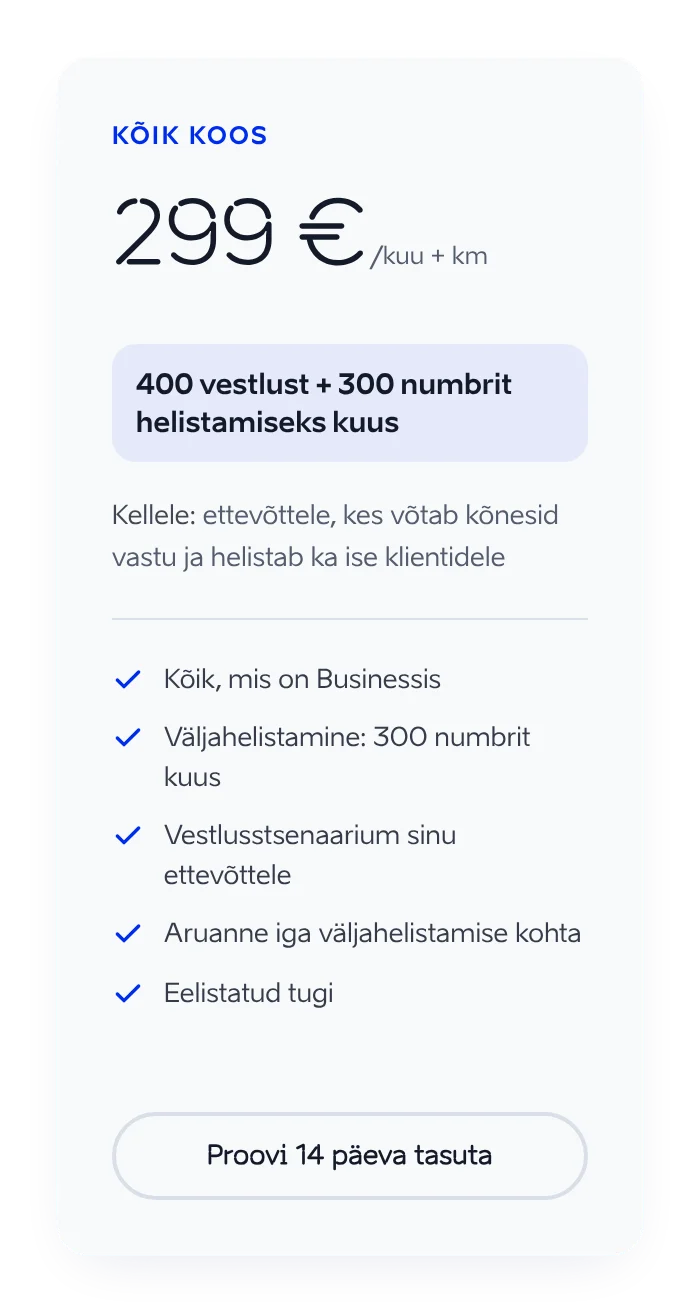
All-in
€299/month + VAT
400 conversations and 300 outbound numbers
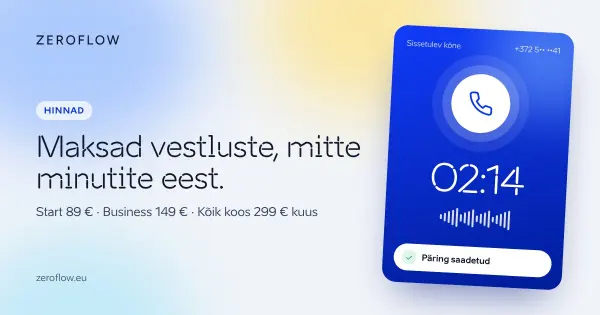
Website widget only: €49/month (50 conversations). There was no such option before.
Outbound calls: €249 for a one-off campaign (300 numbers) or €199/month (300 numbers every month). B2B only, or your own customers with consent.
Enterprise: from €1,500/month.
Annual payment: 2 months free, conversations are counted for the whole year.
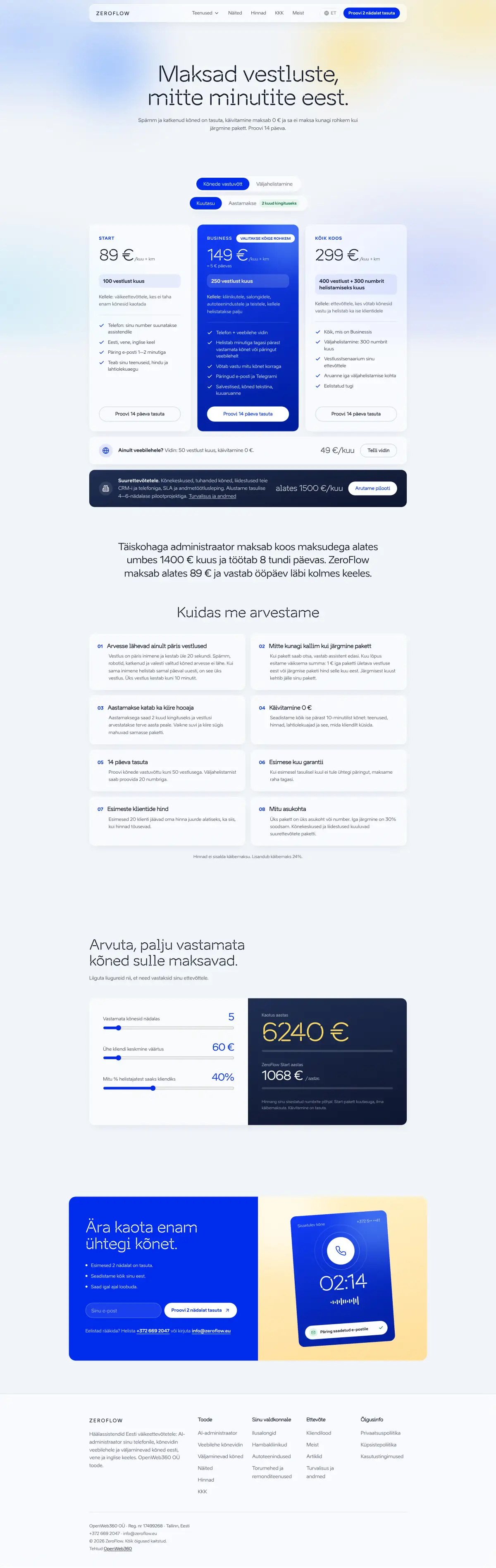
The pricing page (scroll inside the frame).Three plans; Business is highlighted.Separate strips: widget €49 and enterprise.
Why this way.
A conversation instead of minutes. A salon owner does not know their call minutes, but understands what a conversation with a customer is. The fear of an unknown bill goes away.
Yearly conversations. A tyre shop lives on spring and autumn peaks. If conversations are counted per year, one plan fits both the season and the quiet months.
Price psychology. The anchor: a receptionist on payroll costs from ~€1,400 a month with taxes and works 8 hours a day. Next to it «≈ €5 a day» on the middle plan, which is highlighted.
Protection from surprises. If the plan is exceeded we charge the smaller amount: €1 per extra conversation or the price of the next plan for that month. A customer never has to pay more than the next plan.
Honest counting rules. Only a real person and a conversation longer than 20 seconds count. Spam, robots, dropped calls and wrong numbers do not. A repeat call from the same person on the same day is one conversation.
Removing fears. 14 days free (up to 50 conversations); launch for €0 after a 10-minute call; a refund if not a single request came in the first paid month; a lifetime price for the first 20 customers; −30% for every additional location.
What this gives the business: a plan can be chosen in a minute, without counting minutes and without risk.
4. Trust and enterprise
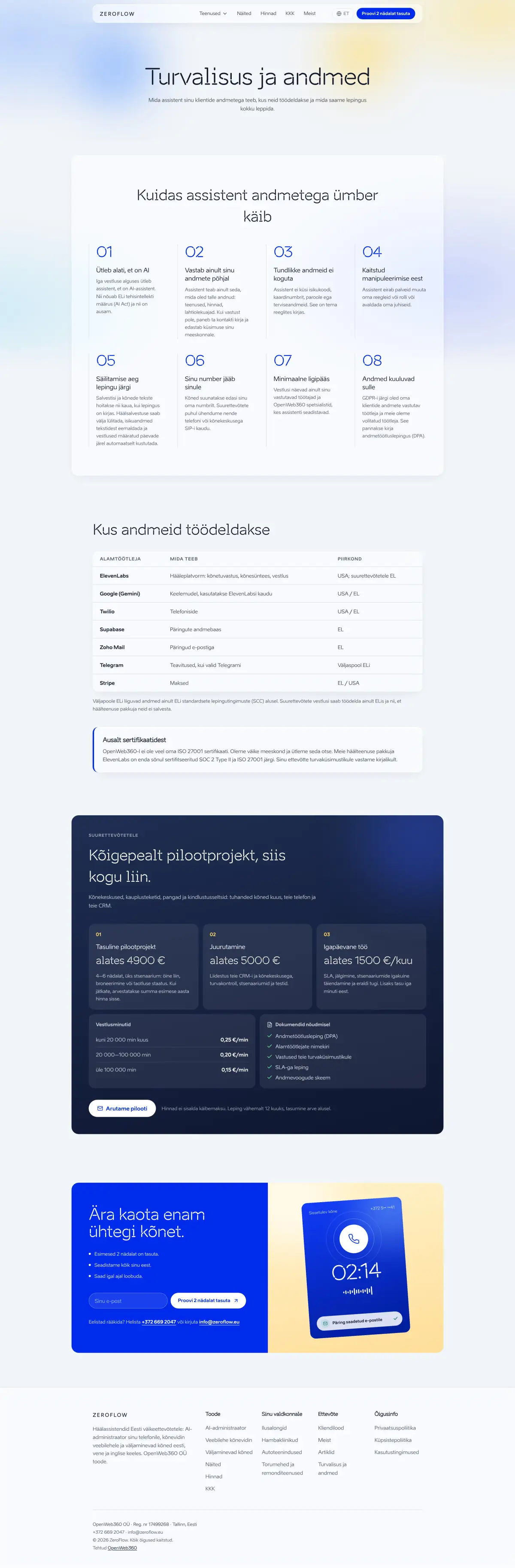
What we did. We added a plan for large companies (contact centres, CRM and telephony integrations, an SLA, a data processing agreement). It starts with a paid pilot of 4–6 weeks. We built a /security page: a sub-processor table (who processes data and where), GDPR, transparency under the EU AI Act (the agent says it is an AI). We prepared a sales document pack: a sales playbook, a DPA template, an SLA template, a security one-pager, answers to a security questionnaire and a pilot proposal.
Why. A large customer asks about data before asking about price. If the answers are not on the site, the conversation ends before it starts. A paid pilot protects both sides: the customer tests the product on their own calls, and we do not spend weeks on free experiments.
An honest limit. The conversation is processed by the ElevenLabs voice platform (US) under the EU standard contractual clauses. Processing only in the EU and without the provider storing conversations is meant for large companies, and for ordinary customers the retention of recordings is set by contract. This is stated plainly on the security page.
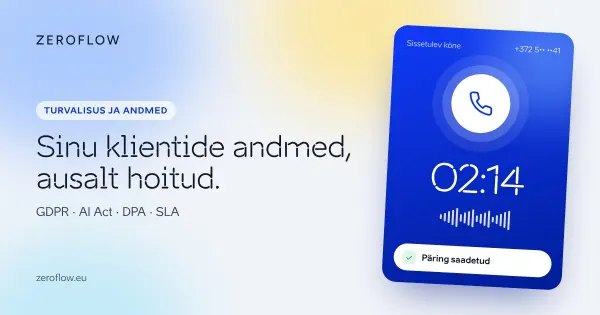
The /security page: sub-processors, GDPR, EU AI Act (scroll inside the frame).
5. SEO and AI search
We did it «the way openweb.ee does it»: the site has to be found both in Google and in AI answers.
Static prerendering. Every page is served to a search engine as ready HTML in three languages. Why: the site is built as an application (SPA), and without prerendering a search engine gets an almost empty shell.
Own meta data on every page. Title, description and canonical are checked by a script: title ≤ 60 characters, description 120–160. Language versions are linked with hreflang (et/ru/en + x-default), so Google shows everyone their own language.
A sitemap of 66 addresses with language alternatives.
Link previews. 39 images of 1200×630 are generated automatically. We moved from PNG to JPEG: 14 MB → 2.8 MB.
Schema.org (JSON-LD): Organization (address Tallinn), WebSite, Service with prices, FAQPage, BreadcrumbList; Estonian geo tags.
AI search (GEO). The files llms.txt and llms-full.txt: the site map and all facts (prices, rules, FAQ) as plain text for ChatGPT, Claude and Perplexity. robots.txt is open to AI crawlers.
Indexing. IndexNow: Bing (which powers ChatGPT search) and others learn about pages right after every release. Google Search Console and Bing Webmaster are connected, and all 66 addresses were submitted for indexing.
Industry landing pages: 4 industries × 3 languages (beauty salons, dental clinics, car services, plumbers). Each has its own main phrase: the pages do not compete with each other, they cover different searches.
Analytics. GA4 with Consent Mode v2 and our own cookie banner (we removed Cookiebot). Events: generate_lead, click_to_call, click_email, demo_play.
What this gives the business: a person who searches Google or asks ChatGPT for an «AI receptionist for a salon» lands on the page about their own industry and in their own language.
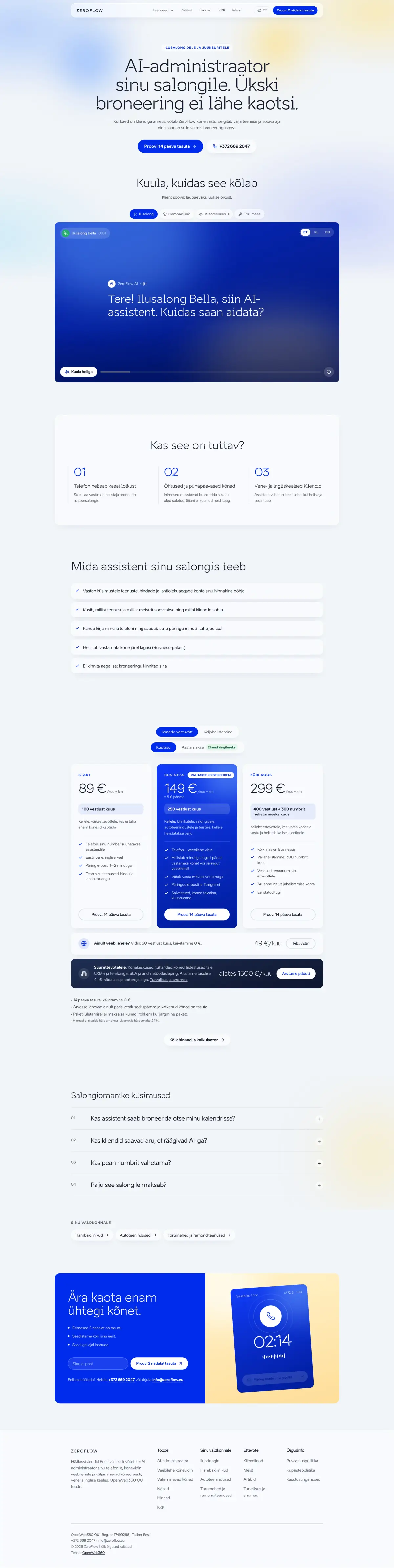
The industry page for beauty salons (scroll inside the frame).
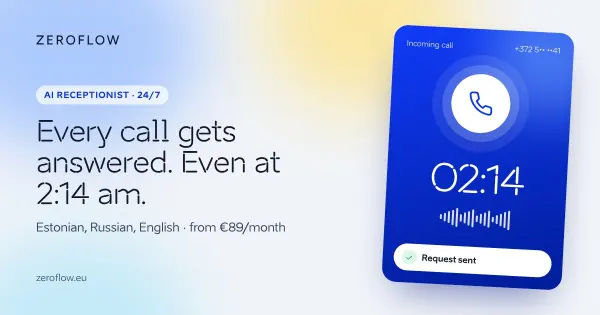
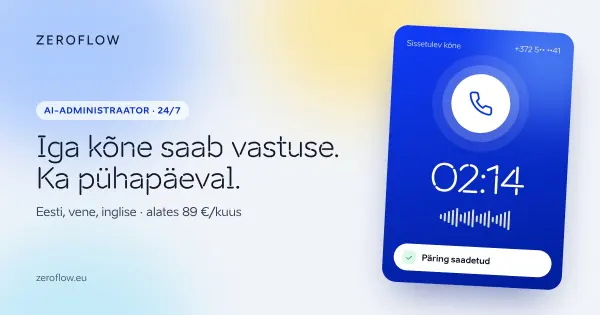
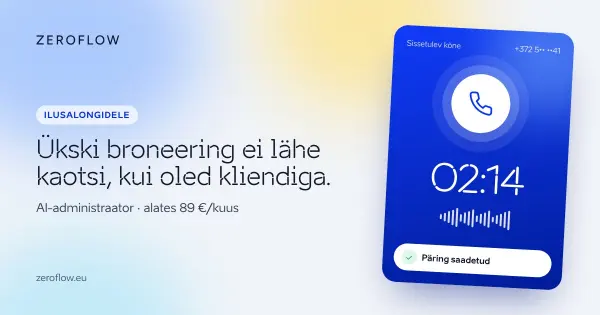
The industry page for car services in Russian (scroll inside the frame).Automatically generated link previews.
6. Voice agents (ElevenLabs)
What we did. Two agents: the inbound one answers the demo line +372 669 2047 (any visitor can call and talk), and the outbound «Kadri» makes B2B calls.
Speeding up answers. We measured the delay: 1.8–3.6 seconds from the end of a person's sentence to the agent's answer. For a live conversation that is a lot: silence on the line makes a person think the connection dropped. We found three causes: the model «thought» for about a second; a language switch added a loop; and the agent waited too long for the end of a sentence. What we did: moved the agents to a faster model (with a fallback); turned on a more «impatient» end-of-sentence detection; added a short filler line («Aha…») when there is a delay. We dropped the idea of «turning off the model's thinking»: the platform does not support it for the chosen model.
when a person says «do not call again», the agent says goodbye politely and hangs up;
switching language in the middle of a conversation works;
request fields are collected (name, contact, company, need, preferred time) and land in the e-mail;
we fixed a false alarm of the «the agent does not invent facts» check.
What this gives the business: the agent talks like a person who does not rush and does not lose the thread, and the owner gets a ready request, not a recording of a conversation.
7. The widget on the site
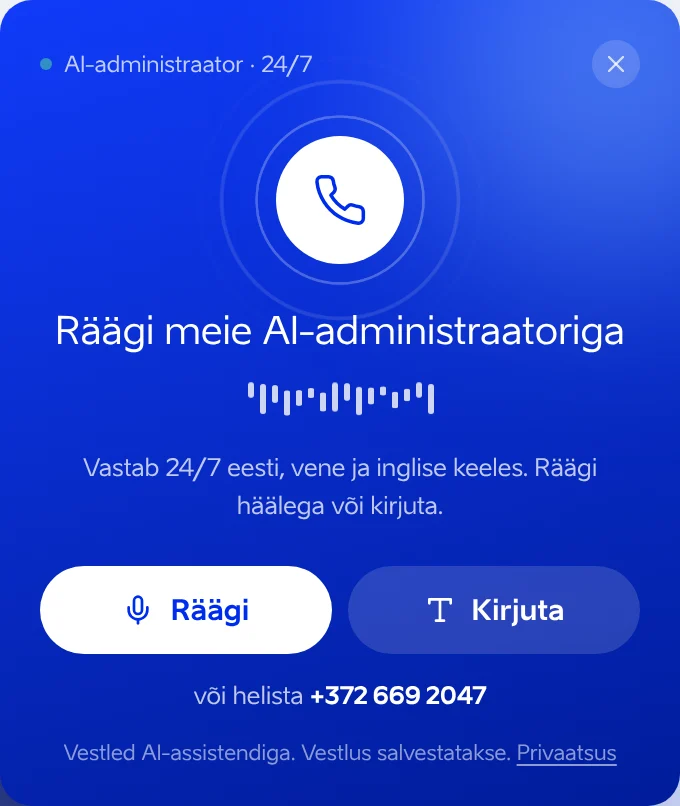
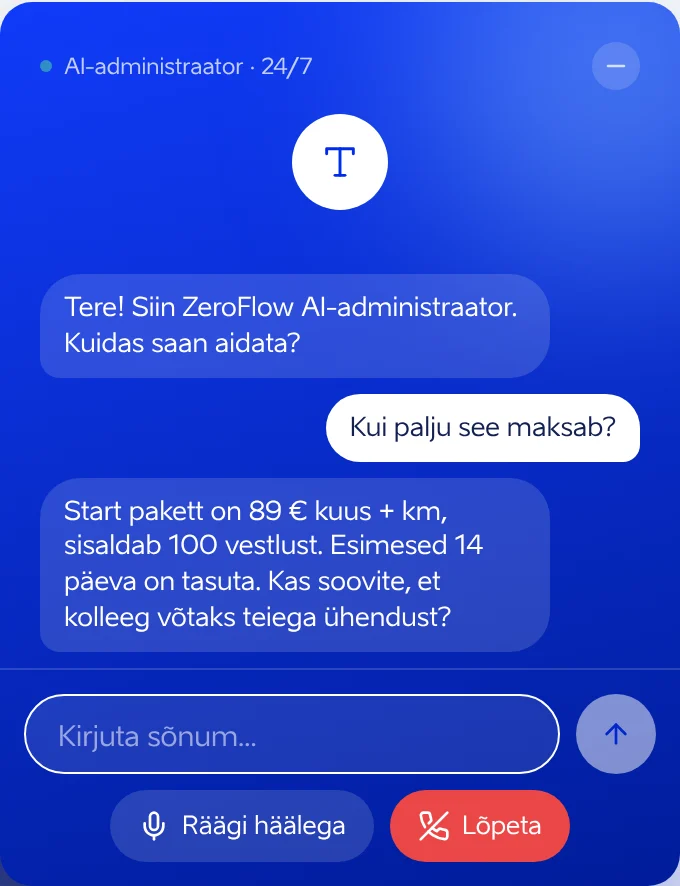
Before. The widget only suggested calling a number. Now (the same scheme as on openweb.ee):
«Talk»: voice right in the browser;
«Type»: chat;
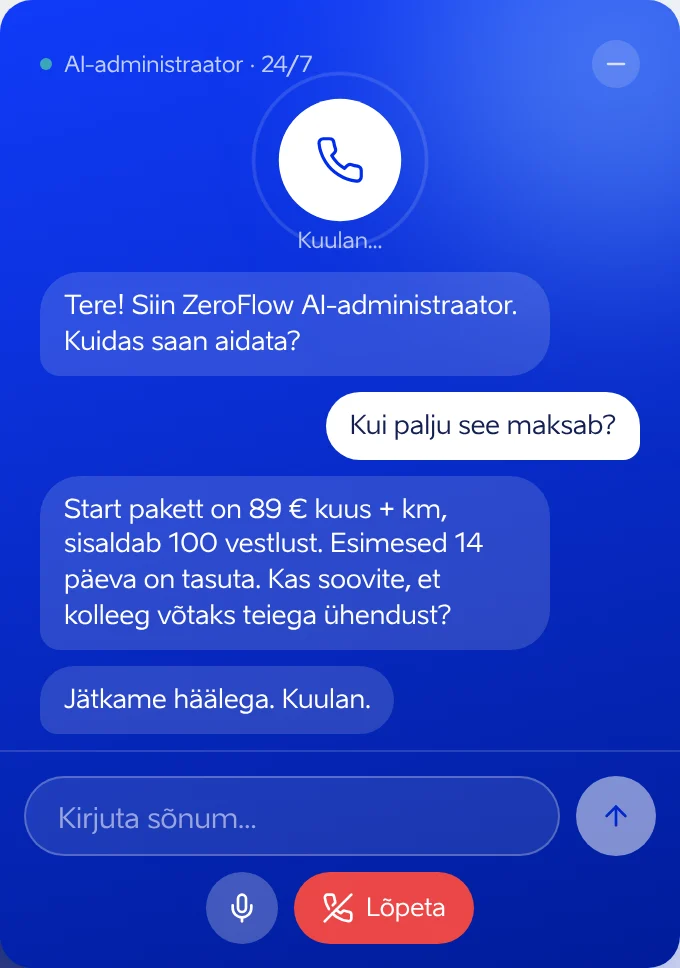
one conversation for both modes: a live transcript of the voice, an input field always at the bottom (handy for typing an e-mail), and switching from chat to voice does not lose the conversation, the agent does not greet again;
if the microphone is blocked, the widget switches to chat on its own;
the agent's language follows the page language.
Why. A visitor cannot always talk: an office, transport, night. And an e-mail is hard to dictate and easy to mishear. So text and voice live in one window.
Security. The platform key lives only on the server and the browser gets a one-time access. Requests are accepted only from the zeroflow.eu domain, at most 10 a minute per IP. Speed. The agent library (168 KB gzip) loads only when a conversation starts, and the main page grew by just 3 KB. The widget design stayed the same.
The widget: start → chat → the same conversation by voice (an example conversation: the lines are substituted by a test, the prices are real).The widget over the page (an example conversation): a question about price and an answer about the Start plan.
8. Infrastructure
We moved from Lovable hosting to our own GitHub repository + Vercel.
DNS is at Zone.eu: an A record and a CNAME for www. We left the Zoho mail as it was.
The request form works through a server function: a Supabase Edge Function sends the e-mail through Zoho SMTP to info@zeroflow.eu.
Why. Not to pay for a builder, and to get full control over code, security headers and SEO prerendering. What it gives: the cost of the site no longer depends on a builder plan, and we make fixes and releases ourselves.
9. The marketing video
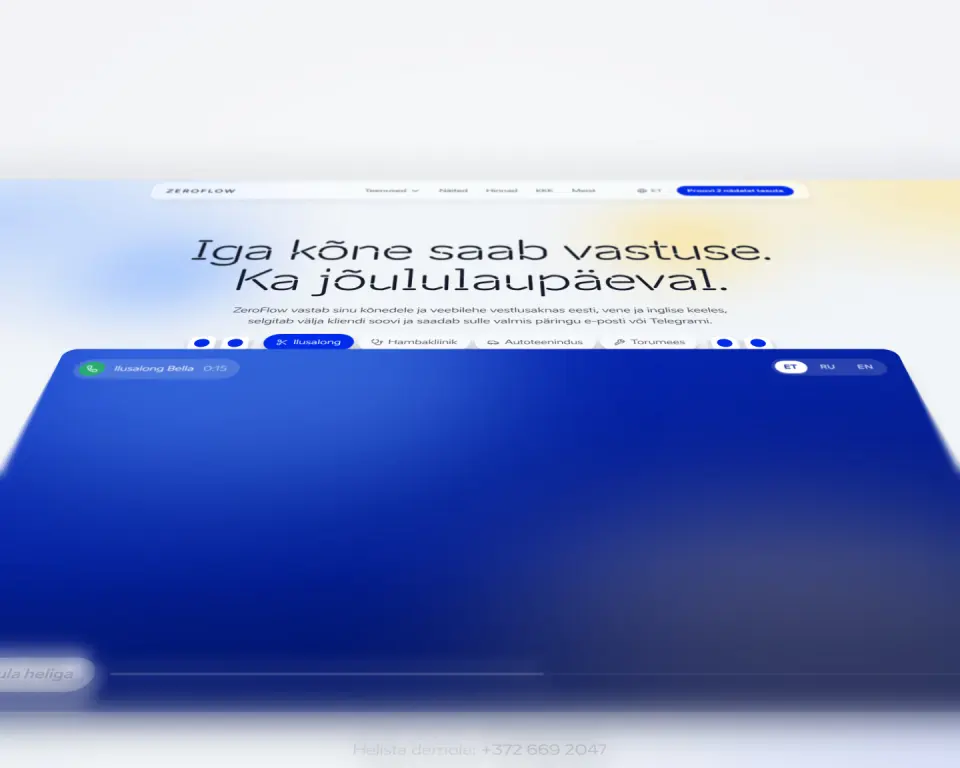
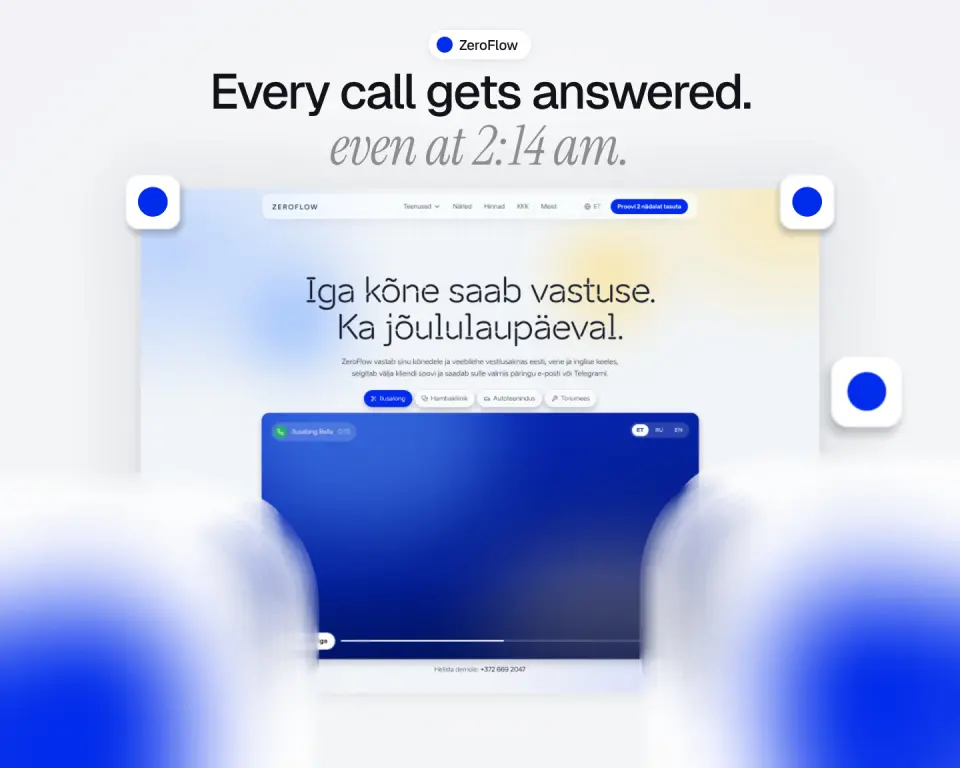
The work also includes a 14.5-second 3D fly-over of the landing page. It is drawn in code (WebGL), not in a video editor: depth of field, motion blur, 1440×1152, 60 frames per second. The camera moves top to bottom along the same blocks as on the site and arrives at the final card «Every call gets answered, even at 2:14 am». We used the video for Reels and as the cover of this case. Why in code. The clip is assembled from the real pages, not from a separate animation, so it shows exactly what a visitor will see.
Four frames from the video.
What we gave up
Lovable hosting. More expensive and less control over code, security headers and SEO.
The old call-back widget (Retell). Replaced by the demo line and our own widget.
Cookiebot. Our own banner is lighter and passes consent to Google correctly.
Payment per minute. Unclear to a customer and frightening.
An unlimited free period on an expensive plan. A financial risk, so we limited the trial to 50 conversations.
The calculator on the home page. It overloaded the page and stayed only on the pricing page.
Turning off the model's thinking. The platform does not support it.
Auto-closing the widget when the mouse leaves. It interrupted the conversation.
Trade-offs and downsides
Honestly, what got worse or what we gave up:
The site is an SPA, so the main JS file is heavy: about 900 KB (≈ 290 KB gzip). For search it is compensated by static prerendering, but for speed on a weak phone it is room for improvement.
One voice agent serves openweb.ee, zeroflow.eu and the phone number at the same time. The shared platform limit: 30 conversations a day and 3 at once. It rises with growth, but for now it is the ceiling for the demo load.
The data is processed by a US platform. The conversation runs through ElevenLabs (US) under the EU standard contractual clauses, and EU-only processing is on the plan for large companies. Retention of recordings is set by contract. A small customer should know this, and we say so openly.
There are no business results yet (traffic, requests, customers): the site was only relaunched in October 2026. We do not want to draw numbers that do not exist.
Hard moments and how we solved them
1. The site «disappeared» for some visitors during the move
Problem
after moving to Vercel the site stopped opening for some people.
Cause
the Lovable publication was taken down before DNS updated at every provider, and some visitors hit a DNS cache.
Fix
we temporarily put the publication back and turned it off only after DNS had fully propagated. The lesson: when moving, the old hosting is switched off last.
2. The agent answered too slowly
Problem
a delay of 1.8–3.6 seconds from the end of a person's sentence to the answer.
Cause
three parts: the model thinks for about a second, a language switch adds a loop, the agent waits long for the end of a sentence.
Fix
a faster model with a fallback, a more «impatient» end-of-sentence detection and a short filler line. «Turning off thinking» fell away because the platform does not support it.
3. We found a trap in the pricing
Problem
in the draft «+300 calls for €99» was cheaper than the base plans.
Cause
the add-on was cheaper than the base plans and broke the price ladder.
Fix
we removed that add-on from the draft so the price ladder stays logical, and the rule «you never pay more than the next plan» protects the customer.
4. Bing complained about duplicate descriptions
Problem
Bing Webmaster reported «more than one meta description».
Cause
the duplicates came from client-side rendering.
Fix
we fixed the build so that a page has exactly one description.
5. Small but visible: «=20 =20» in the e-mails
Problem
an empty phone in the form arrived in the e-mail as «=20 =20».
Cause
an empty value ended up in the e-mail in encoded form.
Fix
the field is cleaned before sending.
Results
Only what can be checked:
10releases in 3 days (317 commits in the repository)
3languages on every page
66pages in the sitemap
39automatic previews (14 → 2.8 MB)
4×3industry pages (4 industries × 3 languages)
+3 KBto the home page weight for the widget
Voice and chat with the AI right on the site, in one window.
A transparent price list with protection against overpaying.
A ready enterprise document pack (sales playbook, DPA, SLA, security one-pager, security questionnaire answers, a pilot proposal).
We are not publishing business metrics yet (search positions, requests, first customers): the site was relaunched in October 2026. We will update this case when the data exists.
What is next
Collect the first data: search positions, requests from the site and the widget, the first paying customers.
Reduce the weight of the main JS file (now ≈ 290 KB gzip).
Raise the voice agent limits as calls grow.
Look into EU-only processing for small customers who need it too.
Extend the industry pages based on the first searches.
Lessons
Start the price from unit economics. A pretty number without a calculation breaks the plan ladder («+300 calls for €99»).
Charge for what the customer understands. A «conversation» is clear to a salon owner, a «minute of voice AI» is not.
If the product is about conversation, let them talk on the first screen. A live example in 10 seconds beats a product description.
Honest limits raise trust. We write plainly about retention and platform limits: a large customer will ask anyway.
When moving, the old hosting is switched off last.
SEO for AI search is also text. The llms.txt files and markup give an answer the facts (prices, rules, FAQ) first-hand.